What is accessibility?
According to the Merriam-Webster Dictionary, “accessible” means “easily used or accessed by people with disabilities / adapted for use by people with disabilities”. In the context of digital products and services, according to W3C (World Wide Web Consortium, the organization developing the standards of the Internet), “web accessibility means that websites, tools, and technologies are designed and developed so that people with disabilities can use them”.
This is also important for regulatory and government bodies for a simple reason: in most cases, businesses are not incentivized to reach adequate levels of accessibility in their digital products, but this puts people with disabilities into an even greater disadvantage. For example, the European Commission defines web accessibility as “[it] allows everyone, including people with disabilities, to perceive, understand, navigate and interact with the Internet“. This is a somewhat different approach from the W3C’s: notice the word “everyone” in this definition. As it turns out, accessibility principles not only help people with disabilities to understand and use digital products, but people with regular physical and mental skills in specific contexts and cases.
For example: using color schemes with enough contrast is recommended by all accessibility standards to make sure content remains readable for people with bad eyesight or color vision deficiencies. If the interfaces don’t reach the required contrast levels however, even people with healthy eyesight might not be able to read content in a bright environment (such as outside when the sun is shining) or when using an old, bad quality or faulty display. Even if the content can be read, it is going to cause more significant eyestrain that leads to eye fatigue, headaches and a deterioration of eyesight over time.
Almost all accessibility principles can be applied to people without disabilities in certain situations. The definition of “disability” also differs somewhat from the medical meaning of the word: bad eyesight and color vision deficiencies (as well as mental symptoms such as cognitive decline) might be considered a disability in a medical sense, there are conditions that we rarely refer to as a disability, such as being a young child with a short attention span or an elderly person with slower reaction times, being distracted or being in an emotionally charged situation, but all of these these conditions influence (often significantly) our sensory and cognitive capacities and how we interact with systems and services.
What is the European Accessibility Act?
It is important for all digital products to reach a level of accessibility so that all customers can use them. To help in the standardization of the Internet, the World Wide Web Consortium (W3C) released a guideline on accessibility requirements in 1999 called Web Content Accessibility Guidelines (WCAG). This went through several iterations since with the most recent version being WCAG 2.2 released in 2023, with WCAG 3 still in the works. Since then, this guideline became an ISO standard called ISO/IEC 40500:2025.
Unfortunately, not all businesses are keen to reach standards when they are not enforced, especially if the return on investment is longer than a few years. This is where regulators and lawmakers make a difference: the European Commission defined the European Accessibility Act in 2019 which came into effect in 2022, with a 3 years grace period for compliance. This means that from 2025, most businesses in the European Union (and businesses looking to operate in EU countries) need to reach certain accessibility standards. The enforcement of the EAA falls on the member states, with each member state implementing the legislation in their own legal framework.
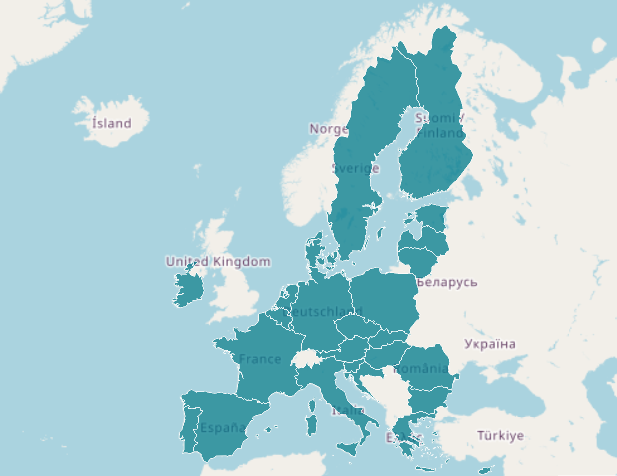
Local legislations implementing the European Accessibility Act in the Member States of the European Union. Data source: Wikipedia
What is included in the European Accessibility Act?
Based on the Web Content Accessibility Guidelines, legislators at the European Commission collected a list of criteria (found in Annex I) that all products and services need to adhere to. These include the requirements for people with disabilities such as:
- lack of or limited vision, including color vision deficiencies
- lack of or limited hearing
- limited physical characteristics, such as limited strength or reach
- limited cognition or an affinity for photosensitive seizures
These assistive technologies also need to be implemented in a way that maintains the privacy of the user.
The criteria are based on ISO/IEC40500:2025, but more generic in scope. The most likely reason for this is that the legislation applies to a wide range of domains and products, and defining more specific requirements would favor one usage scenario or domain more, while causing disproportionate burden for others.
This means that checking if a product meets criteria needs additional interpretation from the usability engineering team, it’s not enough just to go through a predefined checklist; the usability engineers need an understanding of the domain, context and product to make sure they can translate the legislation to a low-level list of items to check for.
Is your business involved?
Short answer: if your business resides or operates in the European Union, there is a high chance the European Accessibility Act applies to you too.
There is a detailed list of which businesses need to pay attention to reaching accessibility standards on their digital platforms. The list includes broad categories such as computers, televisions and smartphones, ATMs, ticketing and check-in machines, banking services, and e-commerce (among others). While the list looks short, the categories are so generic that a large number of digital products design professionals works on during their careers fall into one or the other.
The directive gives a short list of exemptions:
- Microenterprises employing fewer than 10 people and an annual turnover of less than €2 million
- If reaching accessibility standards would cause a disproportionate financial burden (as proven by a formal assessment)
- If reaching accessibility standards would alter the function of the product fundamentally
There are not many enterprises that plans to stay small on purpose, which means if scaling goes as planned, they too will lose their exempt status. Even so, the standards of the European Accessibility Act becomes a strong recommendation for microenterprises.
How to reach compliance?
While most Member States don’t issue fines to businesses based on the European Accessibility Act at the time this article is written, it’s still beneficial to prepare for enforcement. Reaching these standards also creates business value, since the product can cater to a wider audience.
Reaching compliance of the EAA is not a trivial task, but a well-trained usability engineer or team can integrate the accessibility audit into the product lifecycle. Prior evaluation of the current product is often needed to define the compliance strategy. This might also be the right opportunity to define the metrics for usability and the methods of measurement to ensure both the accessibility and usability of the product.
Summary
The European Accessibility Act is a major step in the standardization of accessibility criteria between the Member States of the European Union. The legislation is defined by the European Commission, but enforced by the Member States, so the methods of validating compliance might differ from country to country.
Reaching compliance needs a usability engineer or team who understands accessibility standards (such as the WCAG) and the domain and context of the product. The team needs to define an internal audit process to ensure the product reaches all accessibility criteria consistently.
If your business needs assistance auditing products and services for compliance with the European Accessibility Act, integrating the audit process into the product lifecycle or training your engineers to do the same, the team at neucorti is happy to help. Take a look at our Services page and feel free to contact us!